


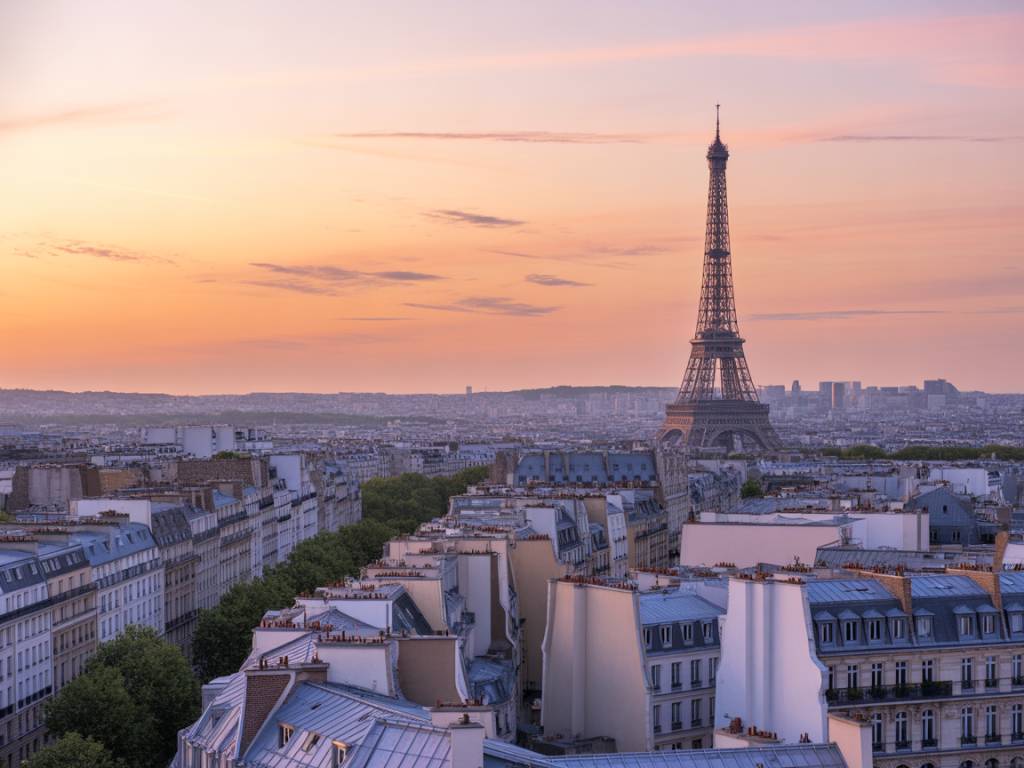
The Eiffel Tower: Classic views from above and below
If you want the postcard skyline – Eiffel Tower, Seine, La Défense in the distance – you have to start with the Iron Lady herself. But depending on where you stand (or how high you go), your photos can être magnifiques… ou vraiment banales.
From the top of the Eiffel Tower
Going up the Tower is obvious, but not always the best option for photos of the Eiffel Tower itself – for a simple reason: when you’re on it, you can’t see it. What you do get, however, is a 360° view over the whole city.
- Best time for photos: About 45 minutes before sunset to catch golden hour, then stay through blue hour when the city lights come on.
- Ticket price: Around 29–36 € per adult for the summit with elevator (depending on age and options). Save money by stopping at the 2nd floor if you don’t need the very top.
- Waiting time: With no reservation in high season, 1–2 hours in line is common. Book online or come on a weekday morning outside holidays.
- Tripod rule: Officially not allowed for “professional-looking” gear; small travel tripods are usually tolerated but be ready to put it away if a guard asks.
Best angles of the Tower from the ground
For actual photos of the Eiffel Tower with the skyline, you’re better off staying on the ground or on nearby viewpoints.
- Trocadéro (Place du Trocadéro, 16th): Classic head-on view across the fountains. Sunrise here is magical and almost empty, while sunset is very busy with influencers, wedding shoots and selfie sticks. Metro: Trocadéro (6, 9). Walk: 5 minutes.
- Pont de Bir-Hakeim (15th/16th): My personal favorite. The iron structure creates a frame for the Tower, and you can include the Seine and boats. Come just after sunset; the bridge lamps plus the Tower lights make the scene. Metro: Bir-Hakeim (6) or Passy (6).
- Champ de Mars (7th): Great for picnic shots with the Tower in the background. Early morning, you’ll mainly share it with joggers and dog walkers. After 11:00, expect crowds and more vendors than grass.
Last July, a German couple asked me, right in front of the fountains at Trocadéro, “Where do the real photographers go?” I pointed them to Bir-Hakeim. We met again an hour later on the bridge – their phones full of much better shots and no crowd behind them. Sometimes 800 meters of walking changes everything.
Arc de Triomphe: The 360° rooftop that actually feels like Paris
For many visitors, this is the best compromise: you see the Eiffel Tower, the Champs-Élysées, La Défense, and the typical Haussmann rooftops, all from a height that still feels human-sized.
- View type: 360° rooftop terrace, open air, no glass panels blocking your lens.
- Best time: Blue hour and nighttime. Watching the Eiffel Tower sparkle from here every hour on the hour is hard to beat.
- Price: About 16 € for adults; free or reduced for EU residents under 26. Check current rates on the official website.
- Access: Metro Charles de Gaulle–Étoile (1, 2, 6, RER A). From the metro, use the underground passage; never try to cross the roundabout on foot.
- Stairs: About 280 steps. There’s a small elevator primarily for people with reduced mobility; don’t count on it if you’re just avoiding the stairs.
Photo tips
- Day: The radiating avenues are clearer. Great for “spider web” photos of the city’s urban design.
- Night: Car light trails on the roundabout plus the lit Tower in the background. Use a higher ISO and something to stabilize your camera against the parapet.
On a winter evening around 18:30, you can often climb without waiting more than 10 minutes. In August at sunset, I’ve seen lines snaking down the staircase. If you hate queues, aim for a weekday in the off-season or go up an hour before sunset and stay.
Montparnasse Tower: The “ugly” building with the most honest view
Ask any Parisian about Tour Montparnasse and you’ll get a grimace. It’s not pretty. But climb it, and suddenly it becomes the most useful building in town: the Eiffel Tower and all of central Paris spread out in front of you, with no glass in the way on the rooftop.
- View type: Indoor 56th floor + open-air rooftop terrace.
- Best time: Clear days for long-range views; sunset for the Eiffel Tower silhouette. Blue hour is perfect for skyline shots with lights.
- Price: Around 20–22 € per adult. Slightly cheaper online in advance.
- Access: Metro Montparnasse–Bienvenüe (4, 6, 12, 13). From the station, count 5–8 minutes of walking inside the complex before you reach the entrance.
Why it’s worth it
If you’re only going to pay for one high viewpoint and your priority is photography, this is often the smartest choice. You get:
- A centered view on the Eiffel Tower
- The layout of the Seine clearly visible
- No huge queues compared to the Eiffel Tower
- Less stress if you’re carrying a camera bag
One summer evening, I stood on the rooftop next to a family who had skipped the Eiffel Tower elevators after seeing the 2-hour line. They came here instead, paid less, and were already posting their pictures while their friends texted from “still waiting” at Trocadéro. Not as romantic, maybe, but much more efficient.
Montmartre & Sacré-Cœur: Romantic, crowded, still essential
Montmartre is probably the hill you’re picturing if you imagine a “rooftop sea” of Parisian chimneys – especially in late afternoon light.
From the Sacré-Cœur steps
- View type: Wide panorama, relatively low height compared to towers, but extremely photogenic.
- Best time: Early morning for a quiet experience, or sunset for atmosphere (and crowds).
- Price: Free from the steps. The dome (for a higher view) costs around 8–10 €.
- Access: Metro Anvers (2) then 10–15 minutes uphill, or funicular from the bottom of the hill using a normal metro ticket.
At 7:00 on a spring weekday, the esplanade is almost empty: a few locals with takeaway coffee, dogs playing, the city waking up. Come at 19:30 in July and you’ll be sitting knee-to-knee with 500 other people, plus musicians, beer sellers, and pickpockets weaving through the crowd.
Safety tip: Avoid engaging with the “bracelet” scam guys at the bottom of the stairs. Keep your phone in a zipped pocket when moving through dense crowds; the view is wonderful, the pickpockets know it too.
Best angles in Montmartre itself
- Rue de l’Abreuvoir / Maison Rose: For photos mixing charming streets with distant rooftops.
- Rue Lamarck-Caulaincourt: The iconic stairway with a view over the city behind.
- Square Louise Michel: Nice shots looking up toward the basilica, especially during blue hour when the dome is lit.
Rooftop terraces and department stores: Free and underrated
Many visitors don’t realize you can access several rooftop terraces in the city center for free or for the price of a drink. These are excellent for less “touristic” skyline shots.
Galeries Lafayette Haussmann Rooftop (9th)
- View type: Eiffel Tower, Opéra Garnier, sea of rooftops.
- Price: Free access to the terrace. In winter, there may be pop-up bars with slightly inflated drink prices.
- Best time: Late afternoon on a clear day. Morning is good if you want fewer people but the light is harsher.
- Access: Metro Chaussée d’Antin – La Fayette (7, 9) or Opéra (3, 7, 8). Follow signs to the rooftop once inside the store.
Printemps Haussmann Rooftop (9th)
- View type: Panoramic, with a slightly different angle on the Eiffel Tower and Sacré-Cœur in the distance.
- Price: Free access; cafés and bars on the terrace if you want to sit down.
BHV Marais Rooftop – Le Perchoir (4th)
- View type: Hotel de Ville, Notre-Dame (still under renovation but visible), and rooftops of the Marais.
- Price: Access with a drink (around 8–14 € for a cocktail).
- Best time: Warm evenings for a skyline + aperitif combo. Arrive at opening time to avoid the line.
I once escaped a sudden summer storm by ducking into Galeries Lafayette. Instead of waiting it out at the perfume counters, I followed the signs up to the rooftop. Ten minutes later the rain had stopped, the sun came back, and the wet rooftops reflected the light – some of my favorite shots of that year, and it didn’t cost a centime.
Seine bridges: Iconic skyline frames, day and night
The river is your best ally for reflections and open views. Many bridges offer great angles on the monuments without needing to climb anything.
Pont Alexandre III (7th/8th)
- View type: Eiffel Tower, Invalides dome, Grand Palais, all framed by ornate lampposts and statues.
- Best time: Blue hour and night, when the bridge lights and Tower lights combine.
- Access: Metro Invalides (8, 13) or Champs-Élysées – Clemenceau (1, 13).
Pont Neuf & Île de la Cité (1st)
- View type: Classic Parisian river scenes, with views towards the Louvre, the Conciergerie, and the rear of Notre-Dame.
- Best time: Late afternoon for warm light along the Seine; after dark for reflections in the water.
- Access: Metro Pont Neuf (7) or Cité (4).
Photo tip: If you want long-exposure shots of light trails from boats, stand on a stable part of the bridge parapet and use a mini-tripod or press your camera against the stone. Many bridges vibrate slightly when traffic passes, so keep exposures relatively short (1–3 seconds) unless you have very steady support.
Hills and parks: Local views away from the postcard crowds
If you want more of a “where Parisians actually hang out” feeling with your skyline, try the eastern hills.
Parc de Belleville (20th)
- View type: Wide view over central Paris, including the Eiffel Tower in the distance.
- Best time: Sunset, especially in summer when locals gather on the terraces with drinks and snacks.
- Price: Free.
- Access: Metro Couronnes (2) or Belleville (2, 11), then a 10–15 minute uphill walk.
On summer evenings, the grassy slopes turn into an improvised open-air living room: groups of friends, music playing softly, someone sharing a bottle of rosé. It’s not “Instagram perfect” in the polished sense, but if you want your photos to feel like real life, this is the place.
Parc des Buttes-Chaumont (19th)
- View type: Several high points with views toward Sacré-Cœur and the northern skyline.
- Best time: Late afternoon for long shadows and a warm tone. Early mornings are wonderfully calm if you don’t mind a few joggers.
- Price: Free.
- Access: Metro Buttes-Chaumont (7bis) or Laumière (5).
Climb up to the Temple de la Sybille for a romantic vantage point, but watch your step: the paths are uneven and can be slippery after rain. I’ve seen more than one photographer back up for “just one more shot” and almost end up in the bushes.
Less expected viewpoints: For unique compositions
If you’ve already done the big classics, or if you want shots that don’t look identical to every postcard rack, here are a few ideas.
Institut du Monde Arabe terrace (5th)
- View type: View over the Seine, Île de la Cité, and Notre-Dame.
- Price: Terrace is often accessible with a ticket to the museum or a drink at the café (check conditions; they change occasionally).
- Best time: Afternoon when the light hits the cathedral side.
- Access: Metro Jussieu (7, 10) or Cardinal Lemoine (10).
Tour Saint-Jacques (4th)
- View type: Central city, including the Seine and Hôtel de Ville, from a gothic tower.
- Price: Around 10–12 €. Visits are guided and time-slotted; places are limited.
- Best time: Clear afternoons or early evenings.
- Access: Metro Châtelet (1, 4, 7, 11, 14).
La Défense Grande Arche (just outside Paris)
- View type: Perfect alignment along the historical axis: La Défense → Arc de Triomphe → Champs-Élysées → Louvre in the distance.
- Price: Around 15–16 € for access to the roof.
- Best time: Late afternoon for long shadows on the business district.
- Access: RER A or Metro 1, station La Défense.
Day vs night: Planning your skyline photo sessions
You don’t need to chase every sunset of your trip, but a bit of strategy changes everything.
For daytime shots
- Morning: Fewer crowds, softer light. Perfect for Montmartre, Trocadéro, and department store rooftops.
- Midday: Harsher light and more tourists. Better for views that rely on geometry rather than mood, like bridges and La Défense.
- Afternoon: Warmer light, good for river walks and parks.
For night shots
- Blue hour: The 20–40 minutes after sunset when the sky is deep blue but not black. Ideal for mixing city lights and sky color.
- Full night: Perfect if you want strong contrast, starbursts from streetlights, and light trails.
- Eiffel Tower sparkle: Once every hour on the hour after dark, for 5 minutes. Last sparkle is at 1:00 (2:00 in summer) with a different intensity. Best seen from Trocadéro, Pont de Bir-Hakeim, or Arc de Triomphe.
Be aware that the illuminated Eiffel Tower at night is protected by copyright for commercial use. For personal holiday photos, you’re fine. For anything commercial, check the legal details before using these images.
Practical photography tips on the ground in Paris
Some final, very down-to-earth advice from years of watching visitors struggle with bags, guards and sore feet.
- Tripods: Many monuments (Eiffel Tower, Arc de Triomphe, department stores) restrict or refuse large tripods. A mini-tripod or a Gorillapod that you can place on a ledge is often a better bet.
- Bags and gear: On crowded viewpoints like Sacré-Cœur steps or Trocadéro, keep your backpack closed on your front when shooting. Don’t leave anything on the ground “just for a second”.
- Weather checks: Use local apps (like Météo-France) to check not just rain but visibility. There’s no point paying to go up a tower if low clouds hide the skyline.
- Shoes: Between cobblestones, stairs and hills, uncomfortable shoes will kill your motivation faster than any jet lag.
- Back-up plan: If clouds ruin your sunset, switch to a night session: reflections on wet streets, café terraces, and bridges become your best allies.
Paris rewards patience and a bit of walking. The difference between a standard skyline shot and a memorable one is often 30 minutes of extra planning and 500 meters off the obvious route. Start with one or two key viewpoints per day – a tower, a bridge, a rooftop – and leave room for the unplanned scene that catches your eye on the way. That’s usually where your favorite photo will happen.