


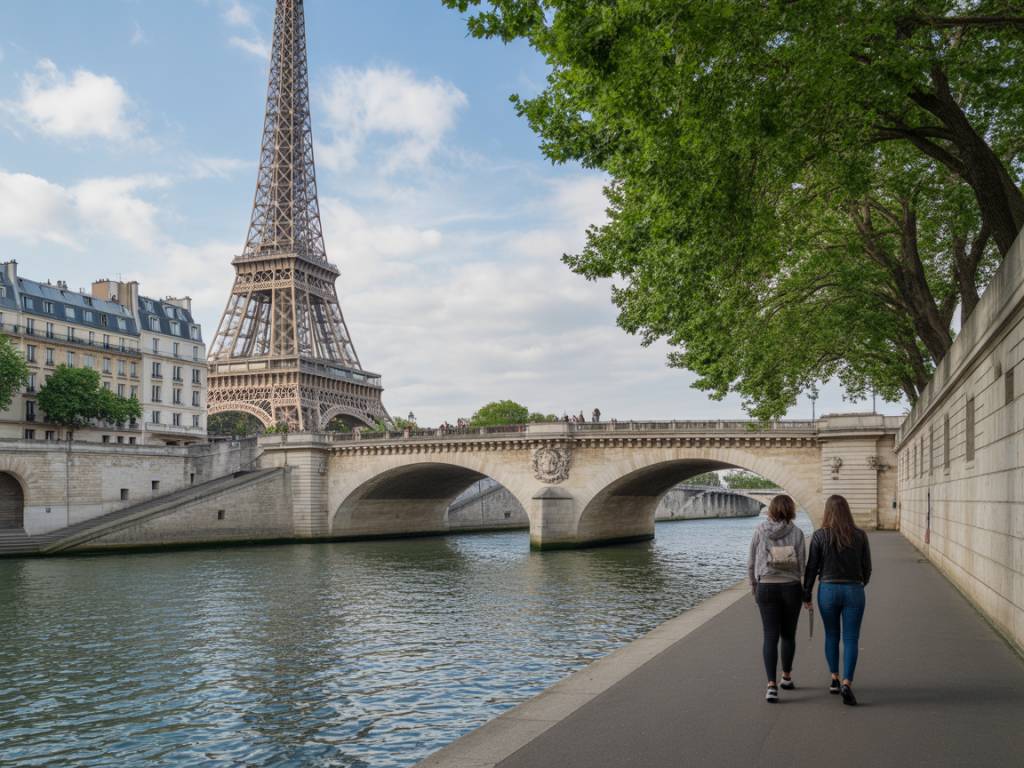
Why the Seine is still the most romantic place in Paris
If you ask Parisians where to feel the “real” city, many won’t say the Eiffel Tower or Montmartre. They’ll say: le quai, the riverbank. The Seine cuts Paris in two, but in practice it brings people together – couples, joggers, dog walkers, and a lot of quiet dreamers staring at the water.
As a former hotel receptionist, I’ve given hundreds of directions to “a nice place to walk by the river”. Over time I noticed something: what most visitors actually want is not a checklist of monuments, but a good, simple route where they can walk hand in hand, stop for a drink without getting scammed, and get home safely on the metro.
In this guide, I’ll share my favorite romantic walks along the Seine, with concrete details: which side of the river to follow, how long the walk really takes, where to sit, what it costs to grab a glass of wine or a crêpe, and how to avoid the worst tourist traps.
How to prepare for a romantic walk along the Seine
Before we dive into specific routes, a few practical tips that can make the difference between “magical evening” and “we argued because we were hungry and cold”.
- Best times of day:
- Early morning (7:00–9:00): almost empty, especially on weekdays. Ideal in spring and early fall.
- Golden hour (1.5 hours before sunset): soft light for photos, street musicians start to appear.
- After dark (21:00–23:30): romantic, but stay on the better-lit sections and main quays.
- What to wear: Parisian cobblestones hate high heels. Choose comfortable shoes; you’ll easily walk 5–8 km without noticing.
- Safety: The quays are generally safe in the evening, especially between Pont Alexandre III and Île Saint-Louis, but:
- Keep bags closed and in front of you in crowded areas.
- Avoid very isolated lower quays late at night; stay near stairs and street level.
- Budget:
- Street crêpes: 3–6 € each.
- Glass of wine by the river (barge bars): 5–9 €.
- Picnic from supermarket/bakery for two: 15–25 € depending on wine/cheese choices.
- Public toilets: Look for the free “Sanisettes” (green cabins) on the upper quays or use café toilets once you’ve ordered something.
Classic postcard route: from Pont Neuf to Notre-Dame
Duration: 45–90 minutes depending on stops
Best time: golden hour to nightfall
Nearest metro: Pont Neuf, Cité, Saint-Michel Notre-Dame
This is the route I used to recommend to couples checking into small hotels around Saint-Germain. It has everything: bridges, islands, old stone, and just enough street life to feel safe and lively.
Start: Pont Neuf (which is not “new” at all)
Despite its name, Pont Neuf is the oldest standing bridge in Paris. The view is already a cliché – but a good one. Stand in the middle, look both ways: on one side, the Louvre; on the other, the towers of Notre-Dame. You can already guess your whole walk just by turning your head.
Step 1: Walk around the western tip of Île de la Cité
Take the stairs down towards Square du Vert-Galant, a tiny park hidden below the level of the bridge. It’s a classic spot where couples sit with a bottle of wine and plastic cups. In summer, you’ll hear bits of conversation in five or six languages at once.
If you continue along the edge of the island, you’ll reach the lower quays facing the Right Bank. This section is calm but can be a little dark in winter evenings, so if it feels too quiet, go back up to street level.
Step 2: Follow the river towards Notre-Dame
Cross back to street level and walk along Quai de la Corse and Quai aux Fleurs. Keep the water on your right. Notre-Dame appears slowly, and that’s part of the charm. Even with the restoration work, the towers and the flying buttresses remain impressive.
On the way, you’ll pass small flower shops and old façades. If one of you likes books, make a quick detour to Shakespeare and Company on the Left Bank, just across Pont au Double.
Good places to pause:
- Benches around Square Jean XXIII, behind Notre-Dame (check current access; sometimes works or closures).
- A simple crêpe stand on the Left Bank near Quai de Montebello: 3–5 € for a crêpe sucre or Nutella, 4–6 € for ham-cheese.
If you still have energy: continue towards Île Saint-Louis and cross Pont Saint-Louis. The ice cream at Berthillon (when open) is not cheap, but it’s one of the rare tourist institutions that still justify the reputation.
Left Bank stroll: from the Louvre to the Eiffel Tower
Duration: 1.5–2.5 hours walking slowly with photo stops
Best time: late afternoon to night
Nearest metro: Louvre–Rivoli, Palais Royal, Tuileries, then various stations along the way
This route is ideal if you want to tick off several major monuments in one continuous, easy walk without feeling like you’re running from sight to sight. You’ll stay mostly on the Left Bank (Rive Gauche), which tends to feel a bit more relaxed than the Right Bank along this section.
Start: facing the Louvre, cross to the Left Bank
From the Louvre courtyard, head towards Pont des Arts (the former “love lock” bridge – the locks are gone, and honestly that’s better for the structure). Cross to the Left Bank and turn right, keeping the river on your right. You’re now on Quai de Conti, then Quai Malaquais.
Step 1: From Pont des Arts to Musée d’Orsay
This is where you start to feel the rhythm of local life: students on the steps, couples with takeaway pizza, small groups drinking wine directly from the bottle. On mild evenings, you’ll often hear a guitarist or a saxophone near the water.
On your left, elegant academic buildings; on your right, the river and, across the water, the long façade of the Louvre. The walk to Musée d’Orsay takes about 15–20 minutes at a slow pace.
Tip from hotel days: if a couple asked me for “somewhere nice but not too expensive” for a glass of wine, I often sent them to small side streets just behind Quai Malaquais. Prices drop as soon as you leave the riverfront.
Step 2: From Orsay to Invalides and Pont Alexandre III
Continue along Quai Anatole France. The Musée d’Orsay clock towers above you on the left. If you like the idea of a quick museum visit before your walk, Orsay is more manageable than the Louvre and closes later on some days (check current hours).
Keep going until you reach the wide Pont Alexandre III, probably the most ornate bridge in Paris. If you arrive around sunset, climb onto the bridge for a panoramic view of the Seine, the Grand Palais, and the Eiffel Tower further down. It’s touristy, yes – but still impressive.
Step 3: From Pont Alexandre III to the Eiffel Tower
Cross back to the Left Bank if you briefly went to the Right Bank, then follow the river along Cours Albert 1er and Quais d’Orsay / Branly. The Eiffel Tower grows larger with each turn. Expect:
- More crowds as you get closer.
- More souvenir sellers, sometimes a bit insistent but usually harmless if you just say “non merci” and keep walking.
- Plenty of spots to sit on the lower quays and watch the boats.
Budget warning: drinks near the Eiffel Tower are predictably pricier. A glass of mediocre wine can easily be 9–12 € on a terrace with a direct view. If you’re on a budget, have your big drink earlier in the walk and just grab a takeaway coffee near the tower.
Romantic extra: if you time it well, you can see the Eiffel Tower sparkle (5 minutes every hour on the hour after dark). One of the nicest spots is on the Right Bank, around Place de Varsovie (Trocadéro side), but that means crossing the river. Plan 10–15 extra minutes to climb the steps.
Quiet charm: Île Saint-Louis and the lower quays
Duration: 45–60 minutes, plus café breaks
Best time: morning or late evening
Nearest metro: Pont Marie, Sully–Morland, Saint-Paul
If you’re allergic to crowds but still want stone houses, small streets, and glimpses of the river, this is a good option. Île Saint-Louis feels like a small village floating in the middle of Paris.
Start: Pont Marie and Quai de Béthune
From metro Pont Marie, cross onto the island and head towards Quai de Béthune, on the eastern side. This is one of the calmest riverwalks in central Paris. Elegant private mansions, no big shops, and benches where locals read or walk their dogs.
In the early morning, you mostly meet residents: a woman walking with her baguette wrapped in paper, a man in a suit walking quickly to the metro. It’s a good moment if you want to feel the rhythm of a “real” island morning rather than a tourist show.
Step 1: Loop of the island
Follow the quay around the island slowly. Each side gives a different view: the Right Bank, the Left Bank, and Île de la Cité. The full loop takes roughly 25–30 minutes if you’re strolling.
Good spots to pause:
- Benches on the southern tip, facing Pont de Sully: very quiet, nice light in the late afternoon.
- Small side streets like Rue des Deux Ponts or Rue Jean du Bellay for cafés and ice cream.
Step 2: Cross to the Left Bank and follow the lower quays
From the southern end of the island, cross Pont de la Tournelle toward the Left Bank. There’s a statue of Sainte Geneviève watching over the city – and nice views back towards Notre-Dame.
Turn right and look for stairs leading down to the lower quays (voies sur berge). This section is usually calmer than the big barge party zones nearer the Eiffel Tower.
On a summer evening, you might find:
- Small informal dance groups (tango, salsa) on the stone platforms.
- Couples picnicking with supermarket cheese, a baguette, and a bottle of wine.
- People stretched out with books, shoes off, feet almost touching the water (don’t try to swim – it’s forbidden and dangerous).
An anecdote from a July evening: I once watched an older couple, maybe around 70, quietly dancing a slow tango on one of these quays. No audience, just them and a small Bluetooth speaker. Meanwhile, a group of Erasmus students were drinking beer five meters away. No one disturbed anyone. That’s the Seine at its best: different generations sharing the same space without really colliding.
Sunset and after-dark vibes: Berges de Seine (Left Bank)
Duration: flexible, 30 minutes to several hours
Best time: after 18:00 when the day cools down
Nearest metro: Assemblée Nationale, Concorde, Invalides
The “Berges de Seine” between Musée d’Orsay and the area near Invalides were transformed into pedestrian promenades. No cars, more space, some bars and café-boats. It’s a good compromise if you want life and atmosphere, but not the chaos of the busiest tourist corners.
What you’ll find along this stretch:
- Deckchairs and seating areas (sometimes free, sometimes linked to a bar).
- Floating cafés and restaurants on barges (expect 6–9 € for a glass of wine, 18–30 € for a main dish depending on the place).
- Occasional open-air exhibitions or installations, especially in spring/summer.
Suggested route: start near Musée d’Orsay, go down to the river, then simply follow the flow towards Invalides and Pont Alexandre III. You can stroll, sit whenever you like and watch the Bateaux-Mouches glide by. At night, the reflections of the bridges in the water are almost more beautiful than the monuments themselves.
If a place looks too “Instagram-perfect” with no prices on the menu – check the price list before ordering. Paris has honest places and also some where the main dish price seems designed for people who will never come back.
Local favorite: from Bibliothèque François-Mitterrand to Austerlitz
Duration: 45–75 minutes
Best time: late afternoon or early evening, especially in summer
Nearest metro: Bibliothèque François-Mitterrand, Quai de la Gare, Gare d’Austerlitz
If you want a more “neighbourhood” atmosphere away from the classic postcard views, head east. It’s less traditionally romantic but more authentic – and you’re more likely to sit next to locals than tourists.
Start: Bibliothèque François-Mitterrand
From the big glass towers of the library, walk down to the river. You’ll find wooden walkways, modern barges converted into bars and restaurants, and a younger crowd, especially on warm evenings and weekends.
Budget-wise, this area can be slightly cheaper than central Paris, but don’t expect miracles: 6–8 € for a beer, 5–8 € for a glass of wine.
Step 1: Walk towards Pont de Bercy and Accor Arena
Follow the river westwards. You’ll pass by the Accor Arena (concert venue) on the Right Bank across the water. On your side, you’ll alternate between modern quays and older stone sections.
Step 2: Towards Gare d’Austerlitz
Continue until you reach Pont de Bercy, then further towards Pont d’Austerlitz. The walk offers more industrial and railway scenery, but also some very peaceful sections with fewer people. It’s a good route if you like to walk and talk for a long time without constant photo stops.
Practically speaking, this stretch is well connected: at almost any point, you can go up to street level and find a metro or bus to get back to your hotel. That’s reassuring if one of you suddenly decides they’ve walked enough for the day.
How to plan a perfect Seine walk date (without overcomplicating it)
You don’t need a big budget or a restaurant reservation to have a memorable evening by the Seine. A little planning goes a long way. Here’s a simple format that works, tested by many of my former hotel guests and friends.
- Pick your “mood” and route:
- Postcard and monuments: Louvre → Orsay → Eiffel Tower route.
- Quiet, old stones: Île Saint-Louis loop.
- Classic Paris romance: Pont Neuf → Notre-Dame.
- Grab a simple picnic: stop at a supermarket and bakery near your starting point.
- Baguette: 1.30–1.60 €.
- Cheese: 3–7 € for a good piece.
- Charcuterie: 3–6 €.
- Affordable bottle of wine: 5–9 € (don’t forget a corkscrew and plastic or reusable cups).
- Check the weather and sunset time: Paris can be windy along the river. A light scarf or jacket is useful even in summer evenings.
- Decide your “escape plan”: before you start, look at the metro map and choose the station where you’ll probably finish. That avoids the tired “and now how do we get home?” debate at 23:00.
One last tip from someone who crosses the Seine almost every day: don’t be obsessed with “the best” spot. The magic often comes from small things – the way the light hits an ordinary building, the sound of a boat passing, a random musician on a bridge. Choose a route, leave room for detours, and let the river do its work.