


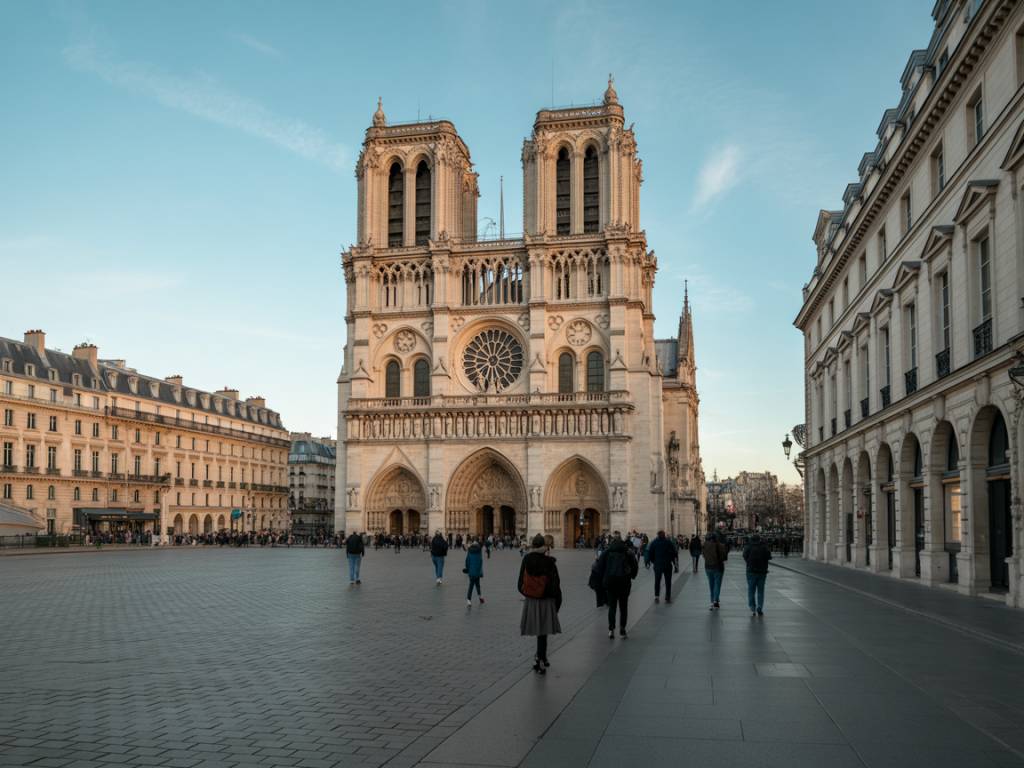
If you only have one half‑day to feel the historic heart of Paris under your feet, the walk from Notre‑Dame to the Louvre is, in my opinion, the best possible use of your time. No tour group, no flag to follow, no headset. Just you, the Seine, and some of the most layered streets in the city.
This self‑guided walk is designed the way I would do it with a friend visiting for the first time: realistic walking times, clear directions, honest comments on what’s worth paying for, and backup plans if something is crowded, closed, or just not your style.
Practical overview of the walk
Distance & walking time
- Pure walking time (without stops): about 35–45 minutes
- With photos, short visits, a coffee and one major paid site: 3 to 4 hours
- With both Sainte‑Chapelle and the Conciergerie plus a proper lunch: 5 to 6 hours
Best time of day
- Morning (9:00–12:00): softer light on the river, fewer crowds, best for photos
- Late afternoon (15:00–18:00): livelier quays and bouquinistes, nice for a drink by the Seine
- After dark, I’d suggest doing only part of this walk and sticking close to the river and main streets if you don’t know the city well.
What you’ll see on the way
- Notre‑Dame and the Ile de la Cité
- Sainte‑Chapelle and the Conciergerie (optional paid visits)
- The Seine quays with bouquinistes (second‑hand bookstalls)
- Pont Neuf and the quietly beautiful Place Dauphine
- The Louvre courtyards and the glass pyramid
What you need
- Comfortable shoes – you’ll be on paving stones and cobbles most of the time
- Offline map (Google Maps or Maps.me downloaded for Paris) in case of network issues
- Small water bottle, especially from April to October
- Weather backup: small umbrella or light rain jacket – showers come quickly here
Now, let’s start where almost every Paris story seems to begin: in front of Notre‑Dame.
Stop 1 – Notre‑Dame and the parvis: how to really experience it now
Exit the metro at Cité (Line 4) or Saint‑Michel Notre‑Dame (RER B/C or Line 4). From both, it’s about a 3–5 minute walk to the front of the cathedral. Just follow the flow of people; they’re almost all heading the same way.
Where to stand first
Don’t rush straight towards the façade. Walk to the middle of the square (the parvis) and stop. This is where you get the classic full view and also where you’ll see the famous “Point Zéro” marker in the ground, the reference point for distances in France.
Take two minutes here just to notice:
- The difference in stone colour between the older and newly restored parts
- The gargoyles and statues above the big doors – most people barely look up
- The buzz of languages around you – this square is a live international soundtrack
Status & access
Because of ongoing restoration work, interior access and visiting conditions change regularly. Before your trip, check the latest info (e.g. on the Paris tourism office site) and assume you might not be able to visit inside or climb the towers. Build your day so that Notre‑Dame is appreciated mostly from the outside, and anything else is a bonus.
Is paying for a guided tour here worth it?
Honestly, right now, not really. Unless you’re passionate about Gothic architecture or religious art, your time and budget will be better spent a few hundred metres away at Sainte‑Chapelle, where the interior experience is much stronger.
Quick detour for a quieter view
Walk to the right side of the cathedral (when you face it) toward the river, then follow the path around the back. You’ll reach the small garden area behind the apse (reopened progressively as works allow). In the morning, you’ll usually find students eating breakfast on a bench, a couple of joggers, and far fewer selfie sticks. The stonework and flying buttresses are actually more impressive from here.
Stop 2 – Ile de la Cité: courts, kings and stained glass
From the back of Notre‑Dame, head towards the centre of the island. In less than 5 minutes you’ll reach the Palais de Justice complex, where two major sites share the same entrance zone: Sainte‑Chapelle and the Conciergerie.
Sainte‑Chapelle – the “wow” moment
If you’re going to pay for just one monument on this walk, make it this one.
- Entry price: around 11–13€ (check current rates)
- Visit time: 30–45 minutes is enough if you’re not doing a full audio tour
- Best time: late morning or mid‑afternoon on a sunny day, when the upper chapel explodes with colour
I still remember a Canadian couple I met here when I was working at a nearby hotel. They came back to the front desk silently, just holding up their phone with a photo of the stained glass and one word: “Worth.” Pretty much sums it up.
Tip: Book a time slot online if you can, especially between April and October or during school holidays. If the queue wraps around the courtyard, you could easily wait 45 minutes without a ticket.
Conciergerie – only if you like history
- Entry price: similar range, 11–13€
- Visit time: 45–60 minutes with exhibits
- Interest level: High if you care about the French Revolution and Marie‑Antoinette, moderate otherwise
The huge Gothic halls are atmospheric, but if you’re short on time or not passionate about history, you can skip it without regret and invest that hour by the river or at the Louvre later.
If you skip both interiors
Just crossing the inner courtyard, looking up at the towers and the gothic detailing, still gives you a good sense of old Paris power – kings, judges, and prisoners all walked these stones. It’s a useful “frame” before you walk towards the more open, everyday city around the river.
Stop 3 – Towards the Left Bank: books, coffee and a first river view
From the Palais de Justice area, exit towards the river and cross the Petit Pont or Pont au Double to reach the Left Bank (the Latin Quarter side). This takes under 5 minutes.
Immediately, the atmosphere changes: more cafés, more students, more noise. Turn right along the river, following Quai de Montebello. This is where you get your first proper postcard‑style view of Notre‑Dame reflected in the water.
Coffee or quick snack stop
- Budget coffee from a takeaway counter: around 2–2.50€
- Basic sit‑down coffee on the quay: 3–4€
- Glass of wine: from 5–6€
Personally, I’d avoid the most aggressively “touristy” terraces right opposite the cathedral – you’ll pay more for average quality. Walk 2–3 minutes further into the side streets of the Latin Quarter and pick a smaller café on a quieter corner. The coffee won’t be magical, but the ratio price/ambiance is usually better.
Optional literary detour: Shakespeare & Company
On the corner facing Notre‑Dame you’ll see Shakespeare & Company, the English‑language bookstore. It’s charming but gets very crowded. If the queue outside is more than 10–15 people, I’d skip it on this walk and come back early another morning. Time is your most limited resource in central Paris.
Stop 4 – Along the Seine: bouquinistes and bridges
From Quai de Montebello, cross back to the island via Pont de l’Archevêché or head directly towards the Pont Saint‑Michel to rejoin the Right Bank side of the river. For this walk, I suggest crossing back to the Right Bank sooner rather than later, because that’s where the Louvre awaits.
Once you’re on the Right Bank, follow the Quai du Louvre in the direction of the Louvre (west, with the river on your left). This stretch takes around 10–15 minutes at a slow pace, longer if you stop at the bouquinistes.
Understanding the bouquinistes
- Opening is unpredictable; on a weekday morning you may find 30–50% of stalls open.
- Prices on vintage books and art prints vary wildly – this is not where you come to “save money”.
- For small, flat souvenirs (a print or postcard), it’s a nice way to support a very Parisian tradition.
I often hear visitors debating whether these stalls are “authentic” or “just tourist traps now”. The truth is: both. You’ll find touristy Eiffel Tower keychains next to serious second‑hand literature. Flip through, talk with the vendor; you’ll quickly feel which is which.
Stay at street level or go down by the water?
- Upper level (quai at street level): easier navigation, more people, better if you’re unsure about safety.
- Lower banks (les berges): closer to the water, quieter, nice views under the bridges, but fewer exits and less lighting at night.
In daytime, the lower banks are generally fine and often more pleasant. At night, if you’re walking alone and don’t know the area, I’d stick to the upper level and main streets.
Stop 5 – Pont Neuf and Place Dauphine: calm in the middle of the city
As you keep walking along the river, you’ll reach Pont Neuf, ironically the oldest standing bridge in Paris. It’s a key midpoint of this walk.
What to do here
- Walk to the middle of the bridge for views both upstream (toward Notre‑Dame) and downstream (toward the Musée d’Orsay and Eiffel Tower in the distance on a clear day).
- Look down to the tip of the Ile de la Cité, called Square du Vert‑Galant – a popular spot for picnics at sunset.
If you have an extra 20–30 minutes and want a short break from the crowds, I recommend detouring into Place Dauphine.
How to reach Place Dauphine
From Pont Neuf, take the stairs down to the island, then follow the small streets behind the equestrian statue of Henri IV. Within 2–3 minutes you’ll emerge into a triangular square framed by charming buildings and a few restaurants.
Why it’s worth it
- Quieter than almost anything else on this route
- Locals playing pétanque on sunny days
- Good place to sit on a bench, recharge and check your map
Prices on the terraces are not cheap, but sitting here with a coffee is more pleasant than on a main tourist strip. Count roughly 4–5€ for a coffee, 7–9€ for a glass of wine.
Stop 6 – Entering the Louvre’s territory: from river to courtyards
Leave Place Dauphine the way you came and cross back over Pont Neuf to the Right Bank, continuing west along the river. In about 5–7 minutes, the architecture changes: long, historic façades stretch along the quay.
This is already the Louvre complex, but most first‑timers only recognise it once they see the glass pyramid. You’re walking next to a former royal palace that has grown, been modified, and repurposed for centuries.
Best way to reach the courtyards
Keep your eyes on the right side of the street and look for a large archway opening into an inner courtyard. You can enter several of these – they are public passageways. One good option is the archway near the Pont des Arts (the pedestrian bridge). Passing through, you’ll arrive in one of the Louvre’s classical courtyards with columns, arcades and often surprisingly few people in the middle of the day.
From there, follow the flow of people heading further inside and you’ll reach the main Cour Napoléon, home of the glass pyramid.
The pyramid: what’s realistic to do on this walk
- Photos & wandering outside: 20–30 minutes
- Full museum visit: minimum 2–3 hours (which turns your “walk” into a full day program)
My honest advice: unless you’ve dedicated a big part of the day and booked a time slot, don’t try to “squeeze in” the Louvre. You’ll waste energy in queues or rushing through galleries and forget half of what you saw.
For this self‑guided walking tour, treat the Louvre as a spectacular destination and backdrop, not a task to complete. Walk around the pyramid, explore the outer courtyards, sit by a fountain, and if you still have energy, continue under the archways into the Tuileries Garden for a final stroll.
Budget for this half‑day walk
Here’s a realistic budget per person for this self‑guided route, assuming you start mid‑morning and finish mid‑afternoon.
- Transport to Notre‑Dame area: 2.15€ for a single metro ticket (less if you use a day pass)
- One paid monument (Sainte‑Chapelle): about 11–13€
- Coffee and pastry: 5–7€ if you avoid the priciest terraces
- Simple lunch or hearty snack (sandwich + drink or salad + drink): 10–15€ in this area, more if you sit in a full‑service restaurant
- Souvenir (small print or postcard from a bouquiniste): 3–10€
Reasonable total: between 30 and 45€ for a half‑day, not counting any Louvre ticket.
If your budget is tighter, you can:
- Skip paid monuments and enjoy only the exteriors
- Buy a takeaway sandwich from a bakery (5–7€) and picnic on a bench near the river
- Stick to takeaway coffees rather than sitting down
Safety and common‑sense tips along the route
This part of Paris is generally safe, but very busy and therefore attractive to pickpockets and scammers.
- Bags: Keep backpacks closed and in front of you in crowds (metro, in front of Notre‑Dame, around the Louvre pyramid).
- Scams: Ignore “petition” girls, “friendship bracelet” guys near bridges, and anyone who “finds” a ring on the ground for you.
- ATMs: Use machines attached to banks on main streets, not stand‑alone ones in quiet corners.
- Night walks: The upper quays and main streets are fine until late evening, but avoid poorly lit lower banks if you’re alone.
One practical note: public toilets exist but are not always where you need them when you need them. Look for the free “Sanisettes” (small grey cabins) or plan to use the restroom in a café where you actually order something – in central Paris, walking in just to use the toilet doesn’t go down well.
If the weather or crowds ruin Plan A
Paris doesn’t always match the postcard. Sometimes it pours, sometimes the queue at Sainte‑Chapelle goes crazy, sometimes there’s a demonstration blocking a bridge. Here are a few easy plan B options directly on or near this route.
If it starts raining hard
- Duck into Saint‑Séverin or another nearby church on the Left Bank for 15–20 minutes of shelter and atmosphere.
- Use one of the covered passages inside the Louvre complex – you can still explore the courtyards and arcades without entering the museum proper.
- Turn this into a café‑hopping walk: choose smaller side‑street cafés over big corner brasseries for better value.
If the monuments are too crowded
- Skip Sainte‑Chapelle and instead spend time in Place Dauphine or along the quieter sections of the river.
- Postpone the Louvre to early morning another day and just enjoy the exterior and Tuileries this time.
- Switch direction after Pont Neuf and walk towards the Marais instead, exploring smaller streets and local boutiques.
If you’re tired sooner than expected
- From Cité or Châtelet metro stations, you can reach almost anywhere in Paris in 20–30 minutes.
- From the Louvre – Rivoli or Palais Royal – Musée du Louvre stations, Line 1 will take you quickly back towards most major hotel areas.
- Don’t force yourself to “finish” the walk; the idea is to enjoy what you do see, not tick boxes.
Making this walk your own
This route from Notre‑Dame to the Louvre is a backbone, not a rigid schedule. You can easily adapt it depending on what you care about most.
- Art lover? Start earlier, pre‑book the Louvre, and end your day there instead of pushing further.
- Food curious? Add a longer lunch stop in the Latin Quarter, or plan a drink on Place Dauphine.
- Photography fan? Do the walk twice: once in the morning light, once at sunset. The same buildings look completely different.
Walks like this are where Paris becomes less of a checklist and more of a city that breathes at a human pace. You’ll remember the way the bells echoed off the stone, the smell of coffee from an open café door, the light filtering through a bridge arch. And that, more than any perfectly posed photo, is what stays with you when you’re back home, far from the Seine.